
Jam de la Culture Yiddish
Le Jam de la Culture Yiddish est un événement chaleureux d'une fin de semaine, axé sur la création culturelle yiddish contemporaine et la collaboration interculturelle.
Le programme présentera et explorera la richesse exceptionnelle de la création artistique et des performances yiddish actuelles, et proposera des ateliers de développement des compétences créatives. Parallèlement à cet accent mis sur les nouvelles œuvres, le programme mettra en valeur la riche tradition d'échanges culturels yiddish en tissant des liens avec les communautés culturelles voisines et en cultivant des espaces de collaboration.
Lancé au cœur de Montréal, le Jam de la Culture Yiddish est le compagnon urbain hivernal de la Retraite estivale de KlezKanada, saluée internationalement. Ce week-end propose un programme d'ateliers, de conférences, de concerts et d'événements sociaux animés par des professeurs invités, ainsi qu'une série d'ateliers animés par les participants mettant en valeur le talent et le savoir de la communauté culturelle yiddish.
Le programme se déroule du jeudi soir au dimanche après-midi et propose des concerts, des conférences, des ateliers pratiques, une programmation de shabes le vendredi et un cabaret.
Les faits saillants
Concert du 26 février : Levyosn !
Avec Adah Hetko, Lysander Jaffe (en nomination aux Grammy Awards), Lexi Ugelow et Raffi Boden.
Levyosn est un groupe de Boston spécialisé dans la chanson yiddish. Le groupe tire son nom du mot hébreu ashkénaze désignant le léviathan, une créature marine mythique parcourant les océans du globe à la recherche de chants, de krill et de rêves. Le groupe a sorti son premier album, « Levyosn’s Lullaby », chez Borscht Beat en 2023 et travaille présentement sur son deuxième album. Leur répertoire comprend des pièces traditionnelles et des compositions originales en yiddish, en hébreu et en anglais, puisant son inspiration dans les traditions folkloriques d'Europe de l'Est. (Photo: Emily Glick)
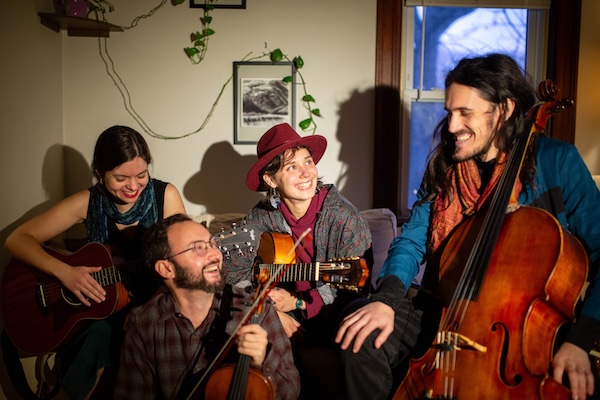
Concert et soirée du 28 février : Le Party de cuisine klezmer !
Avec Isaac Beaudet Lefebvre, Eden Glasman, Zafer Mamilli et des invités spéciaux ! Chérie par de nombreuses traditions culturelles à travers le Canada, le Party de cuisine évoque une ambiance chaleureuse et conviviale, rythmée par la bonne humeur et la musique. Le Party de cuisine klezmer vous invite à découvrir la culture juive, avec la participation des musiciens québécois Isaac Beaudet Lefebvre, Zafer Mamilli, Eden Glasman et des invités spéciaux ! Levez votre verre avec eux pendant qu'ils interprètent des airs klezmer et de la musique traditionnelle québécoise pour violon, et partagent des traductions de chansons yiddish et françaises. La soirée commencera par un concert et se terminera par une soirée dansante !
Alors que nous finalisons les détails du programme d'ateliers Jam de la Culture Yiddish, voici quelques faits saillants :
• Trois ateliers par jour, avec plusieurs options pour chaque créneau horaire.
• Ateliers culinaires et conférences avec Liz Alpern et Jeffrey Yoskowitz de Gefilteria !
• Ateliers pour instrumentistes, chanteurs et danseurs.
• Conférences sur l'histoire, le contexte et la culture yiddish.
• Une série d'ateliers participatifs proposant broderie, contes et bien plus encore. Le programme complet sera bientôt disponible et affiché sur cette page.
Program
Découvrez notre programme ! Cette liste sera mise à jour régulièrement avec les ateliers et événements supplémentaires dès leur confirmation. Toute la programmation est sujette à changement.Tous les programmes seront animés en anglais et/ou en yiddish.
Levyosn
Thursday, February 26, 2026
Casa del Popolo
Levyosn is a Boston-based ensemble specializing in Yiddish song. The band takes its name from the Ashkenazi Hebrew word for the leviathan, a mythical sea creature traveling the world’s oceans collecting songs, krill, and dreams. The band released their debut album, Levyosn’s Lullaby, through Borscht Beat in 2023. Levyosn’s Lullaby has been described as “one of those special recordings that brings joy and a smile each time it is heard” (Ari Davidow) and “a warm Yiddish blanket [to] calm your frayed nerves” (Rokhl Kafrissen). Levyosn’s second album will be released by Borscht Beat in 2026. Their repertoire includes both traditional music and original songs in Yiddish, Hebrew, and English, and draws from adjacent Eastern European folk traditions. Their intricate arrangements and rich vocal harmonies make their sound unique. Levyosn features Adah Hetko (vocals, guitar), Grammy nominee Lysander Jaffe (vocals, violin), Lexi Ugelow (piano, vocals, guitar), and Raffi Boden (cello, vocals, woodblock).
Klezmer Kitchen Party and Dance
Featuring Isaac Beaudet Lefebvre, Eden Glasman, Zafer Mamilli, and special guests
Saturday, February 28, 2026
Ukrainian Federation
Cherished by many cultural traditions across Canada, the kitchen party conjures a welcoming scene of good company, good cheer, and good tunes. The Klezmer Kitchen Party brings Jewish culture to the table, featuring Quebec-based musicians Isaac Beaudet Lefebvre, Zafer Mamilli, Eden Glasman, and special guests! Raise a glass with them as they swap tunes from the klezmer and Quebecois fiddle repertoire and share translations of Yiddish and French songs. The evening will start with a concert and finish with a dance party!
Cello and Tsimbl
Centre de Musiciens du Monde
Raffi Boden and Daniel Kunda Thagard’s new duo features the cello and tsimbl as unique voices, drawing new textures from old material. The two build a raw, trance-like soundscape out of the slow and soulful heart of klezmer music, revelling in the tunes traditionally played at dawn and twilight.
All workshops take place February 26-March 1 between 10 AM - 5:30 PM. Schedule to be announced once confirmed.
Tous les programmes seront animés en anglais et/ou en yiddish.
Yiddish Choir: Raindrops at the Window, Snowflakes on the Ground
with Rona Nadler
This workshop will explore the soundscape of the seasons through contemporary choral arrangements of Yiddish poetry, with an emphasis on female poets including Kadya Molodowsky and Aliza Grinblat. The program will include both traditional and aleatoric compositions, echoing and resounding through the magnificent acoustics of the Église Saint-Enfant-Jésus du Mile-End. Participants should have some choral singing experience. Music reading ability is an asset but not required.
New Yiddish Songs from Scratch
with Adah Hetko and Lexi Ugelow
In this workshop, led by songwriters Lexi Ugelow and Adah Hetko (both of Levyosn), we’ll experiment with building new songs from the following raw ingredients: creative play, supportive community, and short-form Yiddish poetry. We’ll talk about and play with writing new music for existing text, writing singable translations and adaptations, and combining multiple approaches. The workshop will include demos and exercises, time to work independently, and opportunities for sharing and feedback. No songwriting experience or Yiddish language knowledge required.
New Yiddish Song Sing-Along
with Adah Hetko
In this session, Yiddish singer-songwriter Adah Hetko will teach a selection of her original Yiddish songs. Both deeply personal and eminently shareable, these songs have been performed by choirs, taught in Yiddish classrooms, recorded by Levyosn and sung in the shower. Lyrics will be provided in Yiddish letters, transliteration and translation. No singing or Yiddish language experience required.
Embodied Music Theory (for All!)
with Lexi Ugelow
In this workshop we will explore basic elements of music theory through embodied play and activities. Participants will learn about rhythmic and melodic content and will leave with a stronger foundation for further understanding and engagement with the musical language. We will integrate these concepts using our bodies as the instruments, through voice, body percussion and movement. All levels of musical background welcome.
Creative Harmonization – Making Accompaniment Personal
with Raffi Boden
When you accompany a tune, you are essentially composing in real time – choosing your voicing, determining the groove, and deciding how to harmonize the melody. How do we make these decisions within the klezmer idiom? How can we bring our own musical voice and personal taste into our role supporting the melody? This workshop will open the door into these conversations and provide tools and approaches – we’ll be exploring klezmer modes and the chords that fit best within them, experimenting with creative harmonies... and inevitably battling about taste! Geared towards accompaniment players, on any instrument, with basic knowledge of major/minor chords and theory.
Klezmer Piano
with Josh Dolgin
The piano has become one of the most versatile, powerful moving musical parts of a modern “klezmer” ensemble. This workshop will look at Eastern European Jewish wedding music for the piano: how to accompany, how to groove, how to participate in various different Yiddish music ensembles from Belf to 2nd Avenue. The piano is an orchestra by itself with a wide range. It is both a rhythm and a melody instrument, both percussive and stringy. Are there different ways of accompanying different kinds of “klezmer”? What are some tools that might help to develop a “klezmer piano” vocabulary? Through deep listening to source recordings and trying things out on our instruments, we will explore the universe of harmony, rhythm, and groove that makes up Yiddish piano dance music and try to apply it to our playing. For intermediate to serious students of piano.
How Many Ways Can a Klezmer Play a Scale?
with Daniel Kunda Thagard
An important part of learning to play klezmer melodies idiomatically is the study and practice of variations so that you play phrases a little differently every time. But how do you make up variations on the fly and improvise with melodies while still staying within the sound of klezmer music? In this workshop, we'll build up approaches to improvising variations by starting with a scale, an essential building block of this music. We will learn from the ways the great Dave Tarras and Naftule Brandwein improvised variations on this very same scale in their respective recordings of the classic klezmer tune, A Dreydele Far Ale. From there, we will zoom out and experience the tune in a whole new light.
Moskowitz Across Borders
with Daniel Kunda Thagard
Cimbalom virtuoso Joseph Moskowitz got his start playing on river ferry crossing the Danube in Romania, before eventually recording in New York between 1916 and 1953. His repertoire crossed borders and ethnic boundaries, comprising Yiddish, Romanian, Hungarian, Greek, Turkish, Ukrainian, and Russian traditional tunes, popular music, and original compositions. In this workshop, we'll learn some less common tunes from Joseph Moskowitz's transnational repertoire.
Yiddish Dance: Choreographing the Folk
with Avia Moore
How do we understand choreography within folk dance genres? In this Yiddish dance workshop, we will learn dance choreographies new and old and discuss what makes new steps and patterns feel as though they emerge from the tradition? Come and dance a patsh tants (or two!), a terkisher, a troika, and more!
Yiddish Dance: Musical Shers
with Avia Moore
Shers on a shir (shers without end)! An important part of the core Yiddish dance repertoire, shers are Jewish square dances. While we only have a few documented historical variations, new shers are being written within the contemporary renaissance of Yiddish dance. In this workshop, we will learn and dance as many sher variations as we can fit within the two-hour workshop.
Nigunim Throughout the Ages
with Dan Wolfe
This workshop is part of the Yiddish Culture Jam Participant-Led Series
Join Dan Wolfe to learn and sing nigunim--wordless, repetitive melodies--and zmires (songs) both ancient and modern. You will learn older tunes sung by various Hasidic groups (such as Bobov and Karlin), as well as some newer songs and original compositions. No experience necessary.
Klezmer Tunes for Playing and Singing!
This workshop is part of the Yiddish Culture Jam Participant-Led Series
with Rachel Leader and Ariel Shapiro
In this session, we welcome both singers and instrumentalists (all instruments and levels) to explore klezmer tunes that are great for both singing and playing. Many klezmer tunes are also sung as nigns, or even started out that way. We’ll experiment with the interplay of voices and instruments and making jams more accessible to everyone. No prior knowledge needed, bring your voices and instruments – all are welcome.
Let's Write A Tune! A Klezmer Composition Workshop
with Mattias Kaufman
This workshop is part of the Yiddish Culture Jam Participant-Led Series
This workshop is for anyone interested in writing their own music. Mattias will discuss their compositional approach, covering topics such as using traditional and non-traditional source material as models, crafting a melody, working with constraints, overcoming writer’s block, exploring harmony, and developing a personal style. Participants will then have the opportunity to create miniature compositions of their own within a provided framework and receive feedback from the group. Some experience playing an instrument or singing is recommended, but reading or writing musical notation is not required. This workshop welcomes both beginners and those looking to refine their skills. All ages and experience levels are encouraged to participate.
Model-Based Composing: a Particularly Fun Way to Write New Klezmer Tunes
with Nat Seelen
This workshop is part of the Yiddish Culture Jam Participant-Led Series
How can we write new klezmer tunes that sound like, well, klezmer? Model-based composing is one particularly fun way to do it. In this class, we'll analyze a traditional klezmer tune, taking it apart to understand what makes it tick, and then use that tune as a model to write our own original work.
All workshops take place February 26-March 1 between 10 AM - 5:30 PM. Schedule to be announced once confirmed.
Tous les programmes seront animés en anglais et/ou en yiddish.
Embroidering in Yiddish
with Sorke Schneider
This workshop is part of the Yiddish Culture Jam Participant-Led Series
In this hands-on workshop, participants will learn different options for embroidering Yiddish text (backstitch for script, cross-stitch for print), and be supported in designing their own Yiddish language embroidery project (i.e., sketching a design out on paper and starting it on fabric). Some familiarity with embroidery/cross-stitch is good, but as long as people know which end of a needle to hold, they should be ready to get started. This workshop will be scheduled early during the weekend so that you can continue to work on your projects throughout the Yiddish Culture Jam.
GezunTECH
with Sam Berkson
This workshop is part of the Yiddish Culture Jam Participant-Led Series
In this GenzunTECH Workshop you will learn how to safely setup and operate the sound and stage equipment needed for a KlezKabaret or other live event. Lemoshl (for example): speaker/stage design, basic live mixing, sound check criteria, and cable management. This will earn you ultimate mentsh status. Let’s get the shmutz out of those shpeakers!
The Soundscape of Yiddish Poetry: the Pleasure of Declaiming Poems Aloud
with Rivka Augenfeld
This workshop is part of the Yiddish Culture Jam Participant-Led Series
Yiddish classes abound around the world. Yiddish poetry is being rediscovered, read and translated. But where is the sound, the pleasure of reading the words aloud, and the pleasure of discovering new meanings through the spoken words? Rivka Augenfeld has been reciting Yiddish poems--happy, funny, sad and tragic--since she was a young child in her parents home. Then, at various community events, conferences, and commemorations. She discovered that the real meaning of a poem can often be found when saying the words aloud, finding the pace, the rhythm, the path to enhancing the understanding of the words. Participants will be encouraged to read aloud and discuss the content. A working knowledge of reading Yiddish required, the rest will follow. Material will be provided (with English translations).
Playing with Yiddish Poetry
with freygl gertsovski
This workshop is part of the Yiddish Culture Jam Participant-Led Series
In this hands-on workshop, participants will be introduced to examples of found poetry including cut-up poetry, blackout/erasure poetry, and centos–-poetic forms that are created without having to write new texts-–and invited to create their own. Source texts of Yiddish poetry will be available as handouts, in the original Yiddish (oysyes) and in translation, that participants can cut, paste, collage, black out, write on, and use as inspiration for their experimental Yiddish (or translated from Yiddish) poetry. This workshop is to be an inviting, fun, experimental, and accessible way for people of all levels of experience with poetry and with Yiddish to create new Yiddish poems. Found poetry allows participants who feel they ‘can’t write poetry’ to directly play with poetry in a low-barrier way, while also being a challenging and engaging art form. Before the end of the workshop, participants will have the chance to share their new Yiddish poems with the rest of the group.
Research, Rehearse, Resist! : A Practical Performance Methodology from the People's Puppet Parade for Creating New Yiddish Culture in Your Neighbourhood
with Ozzy Irving Gold-Shapiro
This workshop is part of the Yiddish Culture Jam Participant-Led Series
What does it mean to rehearse resistance? What does it mean to truly bring Yiddish language, Ashkenazic gesture, and klezmer music out into the streets? How do we transform archival materials into vibrant multidisciplinary performances that tell our community's stories? And what even is dazzle camouflage? The People's Puppet Parade is an all-ages collective based on Nipmuck, Pocumtuc, and Nonotuck land (so-called Northampton, Massachusetts) that seeks to answer these questions. In the first part of the workshop, participants will be introduced to the methodologies and practices of the People's Puppet Parade, and in the second part, participants will have an chance to put them into action. This is a great workshop for anyone who is curious about transforming research into community-based art. We'll explore how making performances through research builds our capacity for collective imagination and play, deepens communal engagement with Yiddish, creates new living culture, and generates vibrant spaces for intergenerational cultural transmission.
Makhn Mezuzes
with Ava Berkson
This workshop is part of the Yiddish Culture Jam Participant-Led Series
When it comes to Judaism, every body knows about the importance of "stuff". Special cups, special fabrics, special books, and special materials that these things are made out of.... Mezuzes are no exception and add a practical, beautiful, and meaningful addition to any Jewish home. This workshop would provide participants with one or two (or three!) handmade, authentically ceramic mezuzes with which to decorate their home, or give to a loved one. Exploring a brief overview of the history and the importance of the mezuze, as well as a hands-on in-depth (but beginner!) exploration of working with clay. We will answer nail biting questions like: Why do we hang it slanted?; What IS a mezuze?; and What are the physical and chemical limits of clay?
Finding Our Voices in the Jewish Storytelling Tradition
with Weaver
This workshop is part of the Yiddish Culture Jam Participant-Led Series
In this 90 minute workshop, participants will explore some possible definitions of what constitutes "the Jewish storytelling tradition" and look at some examples together of Jewish storytelling, particularly focusing on Rebbe Nachman stories and how they impacted Yiddish literature. Together, participants will analyze what makes a performance of Jewish storytelling 'successful' and try their hand at some brainstorming and writing exercises to develop ideas for their own Jewish stories. There will be opportunities to share at the end. This class will be oriented towards creative writers/theatre makers/other narrative artists, but all disciplines and skill levels are welcome.
All workshops take place February 26-March 1 between 10 AM - 5:30 PM. Schedule to be announced once confirmed.
Tous les programmes seront animés en anglais et/ou en yiddish.
Québec in Yiddish, Yiddish in Québec
with Sebastian Schulman
Bienvenue et brukhim-haboim! Come to any session or come to them all!
Presentation One: Sur un seul pied: A Short History of Yiddish Culture in Québec
Presentation Two: A shtikl eyrope: Depictions of Québec and francophone Quebeckers in Yiddish Literature
Presentation Three: Who was Shabse Perl? Uncovering Montréal lost--and most radical-- Yiddish poet
Montréal and its environs have long been an important point on the map of global Yiddish culture. In these three talks, we'll take a deep dive into the history and literature of this unique centre of Yiddish creativity. In the first presentation, we'll reexamine the history of the region's Jews and their francophone Québécois neighbours--a relationship often depicted as one of distrust and antagonism--and explore how these speakers of joual and zhargon far more in common than might be expected. In the second lecture, we'll plunge into texts by well-known local literati such as Chava Rosenfarb and J.I. Segal to parse out just how Yiddish writers viewed their voisins and the landscapes they shared. In the third session, we'll take the case study of life and work of Shabse Perl, Montréal's most radical leftwing and perhaps least known Yiddish poet, to show how Cold War politics and related shifts in taste have changed how we read, remember, and translate Yiddish.
The Progressive Musical Benevolent Society: a Mutual Aid Society for New York Klezmorim (1890–2010)
with Daniel Carkner
This talk is part of our Participant-Led Series
The Progressive Musical Benevolent Society was a mutual aid and burial society in New York City which counted among its members many of the celebrities of old American klezmer music, as well as upwardly mobile musicians who left klezmer behind. It changed over several eras of New York Jewish life, from its start as a labour union, to a mutual aid and social organization, to mainly being a burial society after WWII. This talk will explain how and why it was formed, what its purpose was, and who some of its notable members were: Brandweins, Beckermans, Levitts, and dozens of now-forgotten musicians and their families.
Imagining Backwards: Queer Yiddish Genealogies in Contemporary Fiction
with Sandra Chiritescu
This talk is part of our Participant-Led Series
In this talk Sandra Chiritescu will discuss two recent examples of queer Jewish fiction that engage with imagined queer genealogies in Eastern Europe: the chapbook Schmutz by Jess Goldman and the novel City of Laughter by Temim Fruchter. Her exploration of queer Yiddish genealogies in these texts draws on Jeffrey Shandler's "Queer Yiddishkayt" and “queer time” as put forward by theorists such as Jack Halberstam, Carol Dinshaw, and José Muñoz, to name just a few. These queer genealogies often operate on the basis of a non-linear temporality and are marked by discontinuities which are especially pronounced given the fractured transmission of Yiddish as a vernacular language throughout the twentieth century. The common stereotypes surrounding Yiddish, such as its “belatedness,” (constant) “death” and (constant) “revival” feed into the natural fit between Yiddish and queer time: Yiddish culture always already exists outside a linear, heteronormative timeline.
In Der Mit: Petaluma Chicken Farmer and Collaborative Art Making Processes
with Yael Horowitz
This workshop is part of the Yiddish Culture Jam Participant-Led Series
This presentation will explore a collaborative project between Etai Rogers-Fett and Yael Horowitz. At a residency in Petaluma, California, Etai and Yael created an artist book and short story about the history of communist Yiddish chicken farmers in Petaluma. The presentation will exhibit the book, will talk about the process of collaboration, and will explore ideas of creating fictive work based on archival research.
An Hour-ish with Moishe Volf-Dolman
with Moishe Volf-Dolman and Avi Gross-Grand
A conversation with Moishe Volf-Dolman – Montrealer, long-time political activist of sorts, Yiddish translator, Yiddish teacher, mishteyns gezogt (so-called, sham, questionable...) Along with Avreml, one of Moishe's students, we'll discuss what, if anything, it means to talk Yiddishly and what, if anything, it means to talk about Yiddish as a countercultural or antiauthoritarian force?"
All workshops take place February 26-March 1 between 10 AM - 5:30 PM. Schedule to be announced once confirmed.
Tous les programmes seront animés en anglais et/ou en yiddish.
The Art of Jewish Pickling (Workshop)
Delve into the world of pickling the old- fashioned way with The Gefilteria's Jeffrey Yoskowitz and Liz Alpern. Make your own jar of sour and half-sour pickles while learning about the exciting world of vegetable fermentation and the Ashkenazi culinary history behind the techniques. You’ll never look at a jar of pickles the same way again.
The Shtetl Kitchen (Talk)
Join The Gefilteria (https://www.gefilteria.com/)'s Jeffrey Yoskowitz and Liz Alpern for a dynamic discussion of Eastern European Jewish foodways, past and present. The Gefilte Manifesto (https://www.gefilteria.com/gefilte-manifesto) co-authors will share exciting discoveries about seasonal Jewish eating, holiday cooking and culinary wisdom which will transform everything you thought about Ashkenazi gastronomy. We'll dive into goose, gefilte fish, cabbage, kugel, and more from the shtetl to the Lower East Side to today's hottest restaurants.
What am I, Chopped Liver? (Demo)
Chopped liver is more than just a deli classic that elicits strong feelings from lovers and haters alike. The Jewish connection to liver tells a unique story of a rich, indulgent dish that was popularized by Jews centuries ago, a byproduct of schmaltz production. It’s loved so much that a vegetarian version of this spread is even more popular now than the original. Join The Gefilteria for a talk and cooking demo all about chopped liver (minus the actual liver!). Vegetarian “mock chop” will be served.
Liz Alpern
Liz Alpern is a passionate cook, author and community organizer. She is co-founder of The Gefilteria and co-author of The Gefilte Manifesto: New Recipes for Old World Jewish Foods. She is also the creator of Queer Soup Night, a global event series highlighting the talent of queer chefs and raising tens of thousands of dollars for locally-based social justice organizations. Liz has traveled the world teaching Yiddish cooking and has been featured on the Forbes 30 Under 30 and the Cherry Bombe 100.
gefilteria.com
Photo: Lydia Lee Photo
Isaac Beaudet Lefebvre
Originally from Mauricie region, Isaac Beaudet Lefebvre was fascinated by Quebec's traditional music from a young age. He initially received classical training in elementary and high school, while learning folklore by ear. He then became familiar with Irish music during several trips to Ireland. Upon returning to Quebec, he explored jazz, completing a degree in jazz composition and arrangement at Cégep de St-Laurent. During his studies, he immersed himself in the world of klezmer music with the group Ichka. And eclectic and passionate fiddler, he can be seen performing with groups such as Kavaz, La Délégation, and the Isabelle Charlot Ensemble, as well as composing and arranging music for storytelling and puppet shows.
ww.kavaz.ca
Photo: Vitor Munhoz
Raffi Boden
Raffi Boden is a NY based cellist, composer, and educator known for his groovy bass lines and his versatility. He has performed internationally and taught at klezmer festivals around the world. Raffi plays with the Magid Ensemble, Levyosn, The Golden Thread Ensemble, contemporary classical quintet the Riwaya Ensemble, and chamber-jazz ensemble Simone Baron & Arco Belo, all of whom have albums coming out in 2025 and 2026. In classical contexts, he has performed internationally in Europe and South America, and locally in Carnegie Hall. Raffi holds degrees from Juilliard and Oberlin. These days, Raffi is freelancing in NY, teaching, and working on singing in Yiddish!
Photo: Lloyd Wolf
Maia Dagher
Maia Dagher est une violoneuse et chanteuse Montréalaise. Elle a étudié auprès de Alexander Read au Conservatoire de musique de Montréal, et avec Éric Favreau au Cégep de Lanaudière à Joliette. Elle est active sur la scène musicale depuis ses 17 ans et est déjà reconnue pour son enthousiasme, son assiduité, et son jeu d’ensemble. Parmi les styles musicaux qu’elle explore sont le trad québécois, la musique celtique, le « old time », le bluegrass, la musique ancienne. Maia est fréquemment engagée pour des concerts et évènements dans ces différents genres musicaux, et elle divertit les foules de l’auberge du Dragon Rouge comme musicienne et animatrice depuis maintenant 3 ans. Elle est avancée dans le jeu de bouzouki irlandais et de la podométrie, en plus du chant et du violon.
Photo: Arthur Rabasa
Josh Dolgin
Josh “Socalled” Dolgin is a pianist, accordionist, composer, magician and producer based in Montreal, Quebec. He has lectured and led master classes in music festivals around the world, from Moscow to Paris, from London to LA, and from Krakow to San Francisco, and has performed on every continent. With 8-ish solo albums (and one with Vulfpeck’s Jack Stratton and Michael Winograd as Yiddishe Pirat) and 6 produced musical comedies to his name, he has performed solo or with his band all over the world for more than 25 years. His list of collaborators knows no generational, social, cultural or religious boundaries: Chilly Gonzales, Itzhak Perlman, Lhasa de Sela, Fred Wesley, Andy Statman, Adam Cohen, Boban Markovic, the Mighty Sparrow, Roxanne Shante, Irving Fields, Killah Priest, Matisyahu, Theodore Bikel, Fanfare Ciocarlia, Enrico Macias and Derrick Carter, to name-drop a few. Dolgin was the subject of The Socalled Movie, a 2010 feature documentary produced by the National Film Board of Canada. Always active doing special projects, he toured with Yiddish programs with Austria’s Lungau Big Band and Germany’s Kaiser Quartett, creates theme songs, directed and released an indie erotica film and created a special program using first world war archives at the Weimar festival of Yiddish culture. He is working on the next Socalled record and is a course lecturer in the Jewish Studies department at McGill University, teaching about the history of Eastern European Yiddish music and “living the archives”.
socalledmusic.com
Photo: Peter Hönnemann
Eden Glasman
Eden Glasman is a violinist from London, UK, based in Quebec since 2013. She is a member of klezmer string ensemble Yene Velt, and is currently studying Ottoman music. As well as playing violin in various local music, theatre, and film projects, she enjoys writing and teaching literature at a college in Montreal.
Photo: Tamim Ahmed
Adah Hetko
Adah Hetko is a Yiddish singer/songwriter, dance-leader, and educator based in Boston, MA. Several of her compositions are featured on the album Levyosn’s Lullaby, recorded with her ensemble Levyosn (Ashkenazi Hebrew for “Leviathan”), and released by Borscht Beat in June 2023, and on the ensemble’s forthcoming second album. Adah has developed her knowledge and skills in many ways, including completing an ethnographic study of contemporary Yiddish women singers (and completing an MA in Jewish Studies at Indiana University in the process), performing with Yiddish song trio Soloveychicks, studying Yiddish song and dance-leading with veteran artist Judy Bressler, and teaching Yiddish songs to students ages 5-95. Adah served as Multidisciplinary Programs Coordinator at KlezKanada for the exciting years 2020-2021, and she is a regular faculty member at Yiddish New York.
Photo: Neil Shapiro
www.levyosnmusic.com
Lysander Jaffe
Lysander Jaffe is a Boston-based violinist, violist, and vocalist, equally at home in chamber music, traditional music, and cross-genre collaborations. Known for his command of East European and Mediterranean folk styles, he balances a busy international touring schedule with a commitment to community music in New England. He is a Co-Artistic Director of Grammy-nominated string orchestra Palaver Strings and a founding member of the Yiddish ensemble Levyosn and the vocal quintet Culomba. He has studied with masters of traditional music in Bulgaria, Kosovo, Greece, Corsica, and Georgia, and is a two-time recipient of the Massachusetts Cultural Council Apprenticeship in Traditional Arts. Lysander holds a Masters in Contemporary Improvisation from New England Conservatory.
lysanderjaffe.com
Photo: Titilayo Ayangade
Ghislain "Gigi" Jutras
Traditional music and dance have been a cherished part of life in the Jutras family of Bas Saint-François, Québec. It was the family stories that inspired Ghislain “Gigi” Jutras to take up calling dances, just like his grandfather Lulu did back in the 1950s. His real spark came during the festive holiday gatherings of his teenage years with the Langlois family in the Eastern Townships. Step by step, he began calling dances in the early 2000s, joining his fellow musicians from the agronomy faculty at university. After 25 years of dancing and calling across the four corners of Québec and beyond, Gigi has honed an energetic, authentic, and unifying style that adapts easily to crowds of all kinds. Whether the setting is a folk festival or an electrotrad party, he delights in sharing that deeply human spirit characteristic of the square dance tradition. Novice or pro, young or young-at-heart — you’ll be swinging and laughing in that irresistible kitchen-party atmosphere!
linktr.ee/ghislainjutras_artiste
Photo: Véronique Chochon
Daniel Kunda Thagard
Daniel Kunda Thagard is a multi-instrumentalist living in Montreal. As a musician, Daniel is deeply involved in the revival of the tsimbl, or Yiddish hammered dulcimer, and contributing to the preservation and revitalization of traditional Jewish music and its co-territorial styles. He performs regularly in the klezmer band Yene Velt, the Greek Smyrnaiko band Toumbeki, and with singer Gabrielle Cloutier. In addition to performing, Daniel is a software developer and a founding member of the Klezmer Archive Project, an initiative dedicated to making klezmer source materials available online for performers, learners, and researchers, and safeguarding the rich heritage of klezmer music.
Photo: Elaine Louw Graham
Zafer Mamilli
Zafer picked up the violin at a classical conservatory. In recent years he has gravitated towards folklore and is presently a member of Yene Velt Yiddish String Ensemble. Zafer is a jammer at heart and is likely to be feeling right at home in a kitchen party!
Photo: Avia Moore
Avia Moore
An internationally-acclaimed teacher of Yiddish dance, Avia Moore leads Yiddish dance workshops for festivals and events around the world, coaches emerging dance leaders, and works as a consultant for choreographers, directors, and teachers seeking to engage with Yiddish movement. Avia is the Artistic Director of KlezKanada and has worked extensively as a creative producer with festivals and cultural organizations across North America as well as on individual artistic projects in North America and Europe. She holds a PhD in Theatre, Dance, and Performance Studies from York University, where she focused on critical approaches to postvernacular Yiddish culture.
www.aviamoore.com
Photo: Shendl Copitman
Rona Nadler
Rona Nadler enjoys a multi-faceted career on the Montreal music scene as a music director, composer, harpsichordist and vocalist. She has performed across the United States and Canada as a member of the quartet Infusion Baroque and is the Artistic Director of the Blue Dawn Quartet and the chamber choir One Equall Musick. Since 2014, Rona has served as Music Director and Cantorial Soloist at Temple Emanu-El-Beth Sholom in Westmount. She is also on faculty at the Schulich School of Music as a vocal coach and the director of the Cappella Antica. Her vocal compositions, setting Yiddish poetry by Kadya Molodowsky, have been performed by numerous ensembles and were recorded by Ensemble ArtChoral for the label ATMA Classique.
bio.site/ronanadler
Photo: Elizabeth Delage
Sebastian Schulman
Sebastian Schulman (he/him) is a multilingual writer and literary translator working in and between English, French, Yiddish, Esperanto, Russian, and other languages. His work has appeared in anthologies and literary journals, including Words Without Borders, Two Lines, and Electric Literature. Schulman’s translation of Spomenka Stimec’s Esperanto-language novel Croatian War Nocturnal was published by Phoneme Media in 2017. He has leadership positions at several cultural institutions, currently serving as the director of special projects and partnerships at the Yiddish Book Center in Amherst, MA. He divides his time between western Massachusetts and Montréal, Québec.
Photo: Self
Lexi Ugelow
Lexi is a vocalist, songwriter, expressive arts workshop and music education facilitator based in Cambridge, MA. She is a life long learner and lover of intergenerational community singing. A professional vocalist and self produced songwriter, Lexi has toured with groups such as Northern Harmony, Culomba, Honey & Soul, and Road Dogs, performing and teaching workshops to adults and children. Though her interests and experience with music spans from funk, to world folk music, you can be always be sure to expect some buttery harmonies. A firm believer that our bodies are our instruments, she encourages the practice of non-judgement during exploration of musical play. Moving into her fifth year as co-music director for Sing Positive, Lexi continues to use music as a way to help others build community, confidence, and self expression.
www.lexiugelow.com
Caterina Kenworthy
Everest Witman
Everest Witman, known for his rock-solid rhythm guitar style, fell in love with traditional music growing up in Brattleboro, VT. Having received mentorship from players such as Keith Murphy and Roger Kahle, he plays in the DADGAD tuning and draws on a variety of styles to inform his playing such as contemporary Irish and Scottish trad. Everest cut his teeth as a musician playing contra dances across the North American continent with the neo-trad trio Nova, who are also a driving force behind the emerging Bal Folk scene in the US. They released their second album, “Chasing the Sunset,” at the end of 2019. Everest currently lives in Montréal, QC where he benefits from the vibrant music scene and plays with the celtic trio Kavaz. When not touring, he works as an audio engineer.
everestwitman.com
Photo: Vitor Munhoz
Jeffrey Yoskowitz
Jeffrey Yoskowitz is a chef-pickler, entrepreneur, and thought leader. He co-founded The Gefilteria, a culinary venture that reimagines Ashkenazi-Jewish cooking and co-authored the award-winning cookbook, The Gefilte Manifesto. He teaches, cooks, and lectures on shtetl cooking and Jewish food history to communities across the globe. His writings on food and culture have appeared in The New York Times, The Atlantic, among other publications. He was featured on Hulu's Taste the Nation for the Hanukkah episode and was recently tapped to represent Jewish culture at the Smithsonian Folklife Festival. He got his start in the food world as a pickle apprentice on an organic farm in the Berkshires.
gefilteria.com
Photo: Zachary Schulman
Rivka Augenfeld
Rivka Augenfeld is a native Yiddish speaker and active member of the Montreal Jewish community.
Ava Berkson
Ava Berkson is a Montréal based visual artist working in the disciplines of ceramics, painting, and drawing through teaching, community engagement, and commission-based work.
Sam Berkson
Sam Berkson is an Ottawa-based audio visual technician, specializing in live music and theatre with a passion in producing music, fashion, and live community events.
Daniel Carkner
Dan Carkner is a Vancouver-based library technician and historian whose research focuses on pre-WWII New York klezmer musicians and their families.
Sandra Chiritescu
Sandra Chiritescu is Clinical Assistant Professor of Yiddish at New York University.
Moishe Volf Dolman, with Avi Gross-Grand
A Yiddish translator and teacher, Moishe Dolman says that he hasn't done enough in life to make up a complete, one-sentence biography; a phrase (no subject, no verb) – maybe.
freygl gertsovski
freygl gertsovski is a cultural producer of community arts programs with Rad Yiddish and a writer based in Tkaronto/toronto, who occasionally writes poetry on faer Yiddish typewriter.
Ozzy Irving Gold-Shapiro
Ozzy Irving Gold-Shapiro is a western Massachusetts-based Yiddishist, performer, researcher, and cultural worker, and the co-organizer of the People's Puppet Parade and KlezCummington.
Yael Horowitz
Yael Horowitz is a PhD student and scholar-practitioner, studying Yiddish Theatre in Poland between the wars and friendship as a site of cultural transmission, in the Theatre and Performance program at the CUNY Graduate Center.
Mattias Kaufmann
Mattias Kaufmann is an accordionist & composer based in Boston, MA.
Rachel Leader and Ariel Shapiro
Ariel Shapiro and Rachel Leader are klezmer musicians and founders/co-organizers of KlezCummington, a grassroots Yiddish in cultural festival hosted annually in Western Massachusetts, and members of musical projects including A Glezele Tey, Magid Ensemble, and Burikes.
Nat Seelen
Nat Seelen is the artistic director of the Boston Festival of New Jewish Music and founding clarinetist with Ezekiel's Wheels Klezmer Band.
Weaver
Weaver is a director, writer, translator, and Yiddish dance leader based in Northampton MA. They are the storyteller of the Magid Ensemble and co-founder of The People’s Puppet Parade, a radical community parade based around the Jewish calendar which facilitates youth leadership and cultural literacy.
Sarah Schneider
Sorke Schneider is a musician, Yiddishist, dancer, crafter, cook, and nature enthusiast based in Ithaca, NY.
Moishe Volf-Dolman, with Avi Gross-Grand
Dan Wolfe
Dan loves singing nigunim, sometimes alone and sometimes with others. He is a member of the Montreal-based klezmer band Yene Velt.
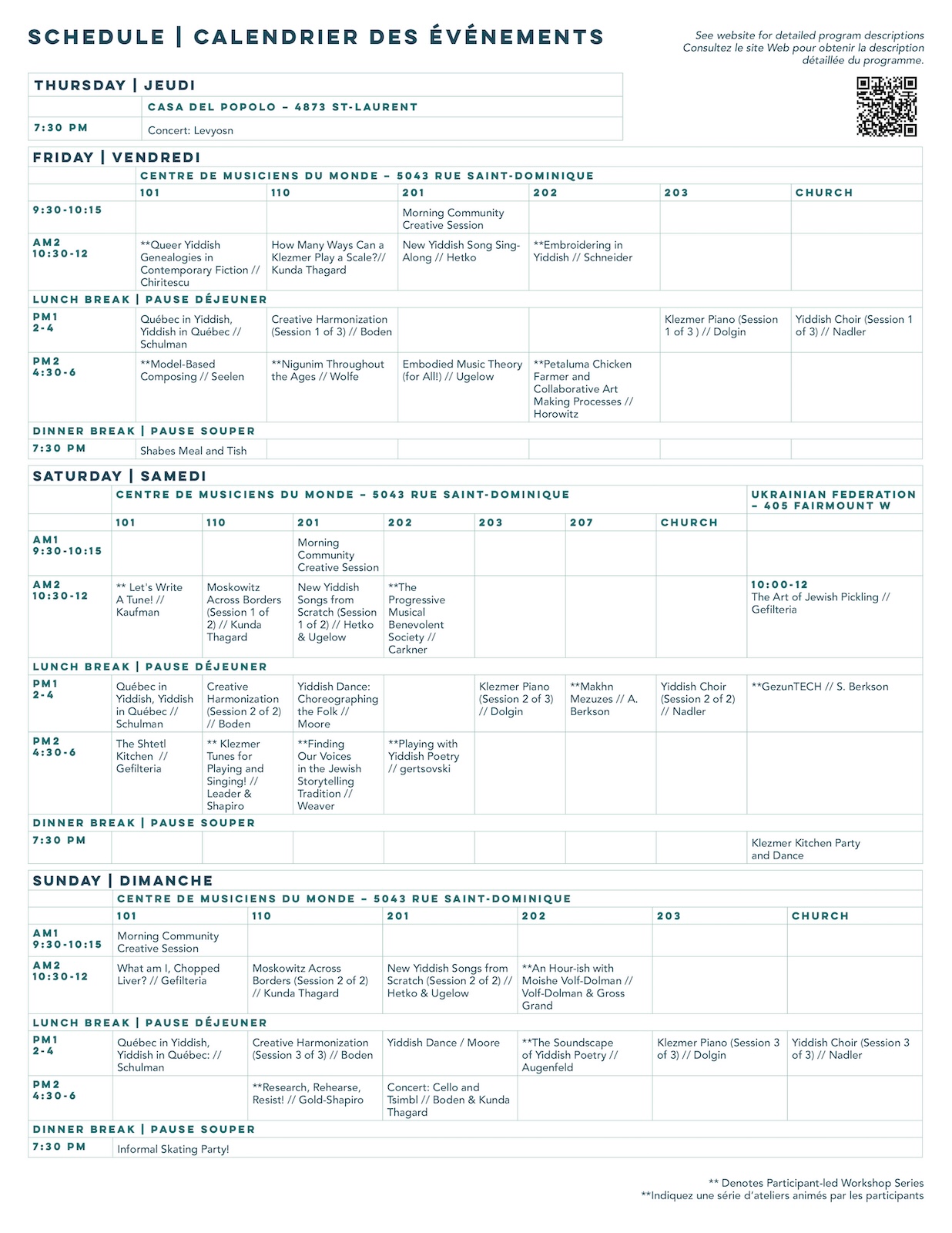
Schedule
Billets pour les programmes
Ateliers individuels : 45/36/27 CA
Série d'ateliers (3 ateliers) : 135/108/81 CA
Série d'ateliers (2 ateliers) : 90/72/54 CA
Billets de concert : 65 $/52 $/39 $ CA
**Des tarifs dégressifs sont disponibles grâce aux codes de réduction au moment du paiement. Voir ci-dessous.
Remarque :
- Si un programme n’est pas affiché, cela signifie qu’il est complet ou réservé aux détenteurs d’un laissez-passer.
- Veuillez noter que les laissez-passer pour l'ensemble du programme ne sont plus disponibles.
Tarifs dégressifs
Le Jam de la Culture Yiddish a mis en place un système de tarification conçu pour rendre le programme accessible à tous. Veuillez noter que le prix choisi n’a aucune incidence sur les options de participation. Veuillez noter que tous les tarifs des billets sont largement subventionnés par KlezKanada grâce à des collectes de fonds.
Option A : Je veux ajouter un montant au prix de mon laissez-passer afin de rendre les événements plus accessibles. Ce prix correspond au prix affiché dans la boutique.
Option B : Je veux payer le prix standard du pass. Utilisez le code de réduction B-PRICE lors du paiement.
Option C : Mon budget est limité et je souhaite bénéficier d’un tarif réduit. Utilisez le code de réduction C-PRICE lors du paiement.
Les tarifs réduits sont possibles grâce au généreux soutien de la Fondation familiale Zita et Mark Bernstein. Si même le tarif réduit ne vous permet pas d'assister au Jam de la Culture Yiddish, n'hésitez pas à nous contacter pour discuter des options disponibles.
Événements partenaires du Yiddish Culture Jam
Préparez-vous pour le Jam de la culture avec ces événements !
21 février 2026 - 18 h 30
Contra Klezmer !
Patro Villeray, 7355 avenue Christophe-Colomb
Rejoignez Montréal Contra et KlezKanada pour une contra klezmer ! Venez danser la contra au son d'un groupe de klezmer en direct, avec Isaac Beaudet Lefebvre, Eden Glasman, Zafer Mamilli, François-Xavier Dueymes et Toby Kimmelman. Les contras seront animés par Mary Wesley et Avia Moore présentera une chorégraphie de danse yiddish. Vous débutez en contra ? Une courte initiation aura lieu à 18h30.
https://www.contramontreal.org/
25 février 2026 - 19 h
Magid Ensemble présente : Shterna & The Lost Voice
La Sotterenea, 4848, boul. Saint-Laurent
Une expérience narrative inédite et immersive, inspirée par le riche patrimoine des contes yiddish, avec une musique klezmer originale interprétée en direct et un spectacle de découpages de papier époustouflant.
Billets
NOUVEAU
28 février -10h à 2h00
AMOUR TOUJOURS
KlezKanada et le Musée juif de Montréal s'associent pour vous présenter une programmation spéciale dans le cadre de la 23e édition de la Nuit Blanche. Joignez-vous à nous pour une soirée dansante au mythique Cinéma L’Amour. Au programme : une sélection d’artistes captivante, concoctée par Josh « Socalled » Dolgin, qui revisitent la musique traditionnelle yiddish à travers leurs performances de danse ; des projections de l'artiste Jennifer Jack et un set du DJ Hex P.
Cette soirée rassemble le thème de la création culturelle yiddish contemporaine, abordé lors de l'événement Jam de la culture Yiddish de KlezKanada, et l’exposition actuelle du Musée juif de Montréal sur l’histoire du Cinéma L’Amour, ancien théâtre de vaudeville situé dans le quartier juif historique de Montréal.
Veuillez noter que les détenteurs d'un laissez-passer pour le Jam de la culture Yiddish bénéficient d'un rabais sur les billets pour cet événement. Un courriel contenant un code promo vous sera envoyé.
Avec les ensembles de :
@h3xpy – Funk House
Ring Hollow – Kleztronica
@socalledentertainment – Vinyle yiddish
Donny Lebowitz – Rap
@buymeflovvers // @ucanquit – Techno ukrainienne
Cet événement est organisé par le Musée juif de Montréal en partenariat avec KlezKanada et POP Montréal. Présenté en collaboration et avec le soutien de Nuit Blanche à Montréal et Montréal en Lumière.
2 mars 2026 - 14 h
Centre Cummings – Concert « Mélodies mémorables » avec Ozzy Gold-Shapiro et Mattias Kaufmann
Centre Cummings, 5700, avenue Westbury
Ozzy Gold-Shapiro et Mattias Kaufmann, duo klezmer originaire du Massachusetts, vous proposent des interprétations originales de chants et de danses folkloriques yiddish, ainsi que des compositions originales en yiddish et en anglais. Venez danser et chanter avec nous !
Entrée libre.
Information supplémentaire
Vous devez être asymptomatique pour participer aux événements.
Nous demandons et recommandons à tous les participants de passer un test rapide de dépistage de la COVID-19 le jeudi précédant le programme. Si vous présentez des symptômes ou si votre test de dépistage de la COVID-19 est positif, veuillez ne pas participer aux activités.
Nous encourageons fortement toutes les personnes pouvant se faire vacciner contre la COVID-19 et la grippe. La vaccination est le moyen le plus efficace de protéger votre communauté et de réduire votre propre risque.
Le port du masque est recommandé dans les espaces intérieurs. Nous recommandons des masques bien ajustés à haute filtration de type FFP2 ou supérieur, comme les masques KN95 ou N95.
N'oubliez pas que vos besoins en matière de sécurité peuvent différer de ceux de votre voisin. Veuillez vous renseigner mutuellement avant de vous embrasser, de vous tenir la main dans une file de danseurs, etc.
FILTRATION DE L'AIR
KlezKanada installera des filtres à air dans tous les espaces intérieurs où sont programmées ses activités.
Le Centre des musiciens du monde (CMM) est situé près du parc Lahaie. Il est proche de la station de métro Laurier (5 à 10 minutes de marche) et des places de stationnement payantes sont disponibles dans les rues avoisinantes.
Les programmes se déroulent principalement au premier et au deuxième étage du CMM, ainsi qu'au rez-de-chaussée et au sous-sol de l'église attenante. Un petit escalier extérieur mène au bâtiment, et un escalier complet mène au deuxième étage. Un escalier mène aussi au sous-sol de l'église attenante. Étant donné qu'il s'agit d'un édifice historique, il n'y a pas d'ascenseur.
Des concerts auront lieu dans des salles satellites voisines du quartier Mile End.
Concert du jeudi soir : La Casa Del Popolo est située sur la rue Saint-Laurent, juste au sud de la rue Saint-Joseph. La salle de spectacle est au rez-de-chaussée. Des rampes d'accès sont installées à l'entrée de la salle et du bar pour les personnes en fauteuil roulant. Les toilettes sont non genrées et l'une d'elles est accessible aux personnes en fauteuil roulant.
Concert du samedi soir : La Fédération ukrainienne est située au coin des rues Fairmount et Hutchison. Le concert aura lieu dans la salle du rez-de-chaussée, accessible par un escalier depuis la rue. L'immeuble n'a pas d'ascenseur.
Pour de plus amples renseignements, veuillez nous contacter à l'adresse info@klezkanada.org.
Le Jam de la Culture Yiddish est présenté en partie grâce au soutien de :

Partenaires promotionnels